
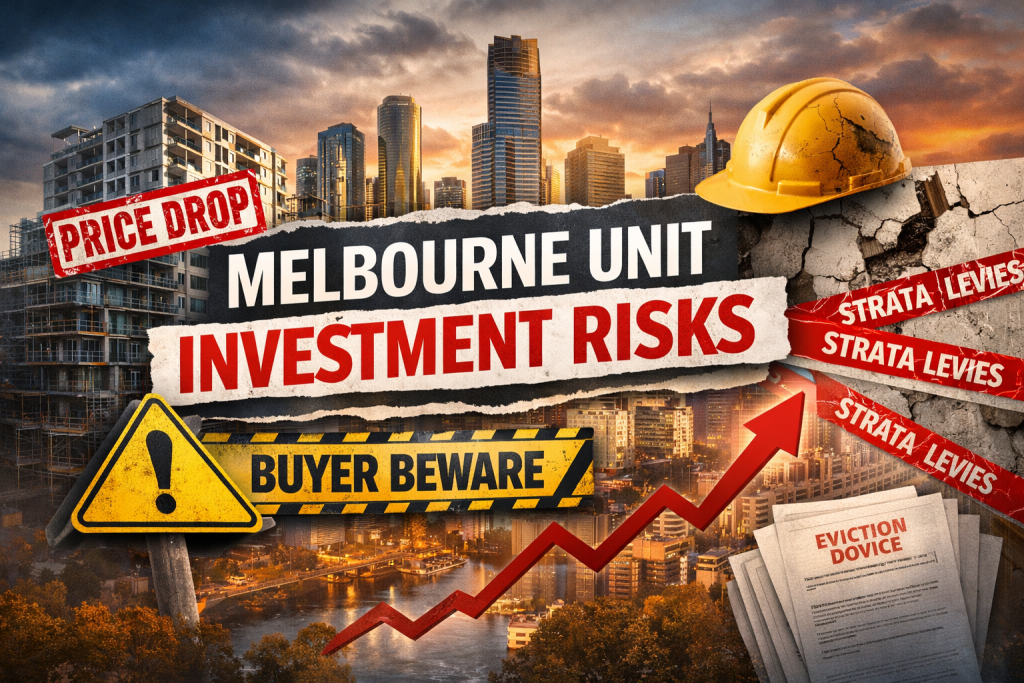
Property Market • Melbourne Units • Investor Risk
Why Melbourne units can be a risky investment — and what buyers need to look out for
For years, Melbourne units have been marketed as the affordable way into property investing. Lower entry prices, inner-city locations and strong rental demand have made them look appealing on paper. But for a lot of buyers, the real story starts after purchase — when growth stalls, holding costs climb, and building issues turn a “cheap” buy into a very expensive lesson.
This is not about saying every Melbourne apartment is a bad purchase. It is about understanding the risks properly — especially in oversupplied pockets, off-the-plan stock, and buildings where strata, defects or resale conditions can do real damage.
The uncomfortable truth about Melbourne unit investing
Melbourne units are often sold as a simple stepping stone: lower purchase price, less maintenance, more affordable entry. That is the sales pitch. The problem is that lower entry cost does not automatically mean lower risk.
In the wrong building or the wrong pocket, a unit can underperform for years while the ownership costs keep climbing. And once problems emerge — whether that is oversupply, soft resale demand, strata blowouts or building defects — owners can find themselves stuck between selling at a loss or holding an asset that no longer makes financial sense.
Core point: a cheap purchase price is not the same thing as good value. In the Melbourne unit market, the hidden risks often matter more than the headline price.
1. Lower entry price does not guarantee better investing
A lot of investors see a unit priced well below a house and assume they are getting an easier path into the market. But units do not behave like land-backed property in the same way detached houses often do.
In many parts of Melbourne, especially where large volumes of similar apartments were built over the last decade, supply has limited capital growth and made resale competition much tougher. If multiple near-identical properties are competing for buyers at the same time, price pressure works against existing owners very quickly.
That is one of the biggest problems in apartment-heavy precincts: when new or unsold stock keeps competing with older resales, the owner trying to exit can end up being undercut by the very market they bought into.
2. The resale trap is real
One of the biggest dangers in the Melbourne unit market is that some owners only realise the weakness when they try to sell. A unit may look fine while it is being rented, but the moment you test the market, the gap between what you paid and what buyers will offer can become painfully clear.
This is especially risky for buyers who purchased off the plan or bought into large investor-focused developments. If the valuation is soft, buyer demand is weaker than expected, or the surrounding supply is heavy, resale outcomes can disappoint badly.
What catches people out: property feels safe while values are theoretical. The real test comes when you need to refinance, settle, or sell.
3. Holding costs can quietly wreck the numbers
A property does not have to crash in value to become a poor investment. Sometimes it just has to go nowhere while your costs rise year after year.
This is where many Melbourne units come unstuck. Mortgage repayments, owners corporation fees, insurance, maintenance, council rates and land tax can all keep moving in the wrong direction while the property itself does very little.
That means even a unit that appears “stable” on paper may actually be eroding your position over time. If growth is flat and the annual cost stack is rising, you are effectively paying more to stand still.
Investors should look at the full annual cost of ownership, not just the mortgage and rent.
4. Strata and building risk are where things can get ugly
This is the part many buyers underestimate. When you buy a unit, you are not only buying the apartment itself — you are buying into a building, an owners corporation, a maintenance culture, a sinking fund, and the decisions of every other owner in that complex.
If the building has cladding issues, waterproofing problems, structural defects, poor maintenance history or underfunded reserves, those problems do not stay hidden forever. They eventually show up as special levies, higher quarterly fees, disputes, insurance pain or serious resale resistance.
And once a defect issue becomes known, the damage is rarely limited to the repair bill itself. Buyers become cautious, valuers become cautious, and lenders can become cautious too.
Important: a unit can look affordable right up until the building asks you for tens of thousands of dollars.
5. Off-the-plan buying can magnify the risk
Off-the-plan purchases can amplify nearly every weakness in the unit market. You are agreeing to a price before the final product exists, before settlement happens, and before the real market has fully judged the value of the property.
If valuations soften before completion, buyers may need to contribute more cash just to settle. If the building is delivered into a weak or oversupplied market, resale conditions can be poor from day one. And if the quality or layout disappoints, the investment case can unravel quickly.
In strong markets, this risk can be hidden. In softer markets, it gets exposed fast.
6. Not every Melbourne apartment is bad — but they are not all equal
It is important to stay balanced here. Not every Melbourne unit is a poor buy, and not every owner is in trouble. Some older boutique blocks, tightly held owner-occupier buildings and well-managed complexes have held up far better than high-density investor towers.
That is the key distinction buyers need to understand. “Melbourne apartments” are not one single market. There is a huge difference between a low-rise, well-run block with a healthy sinking fund and a newer building carrying serious unknowns.
Better question: don’t ask whether Melbourne units are good or bad in general. Ask whether this building, in this location, with this history, is actually worth the risk.
What buyers should check before purchasing a Melbourne unit
Before buying, look well beyond the agent’s ad copy and glossy photos. The smarter move is to investigate the things that can hurt you later.
Due diligence that actually matters
- Owners corporation records: look for special levies, disputes, major repairs and chronic issues.
- Sinking fund health: check whether the building is properly funded or just coasting towards a future cash call.
- Defect history: ask about cladding, waterproofing, structural concerns and remediation works.
- Resale history: see how units in the same building have actually performed.
- Owner-occupier ratio: some buildings are materially stronger when they are not dominated by transient investor stock.
- Nearby supply: if hundreds of similar units are still coming online, your resale competition may stay fierce.
- Total cost stack: run the maths on mortgage, strata, rates, insurance, tax and maintenance together.
The bottom line
The danger in the Melbourne unit market is not that every apartment is terrible. The danger is that many buyers assume a lower price means a safer decision, when in reality the opposite can be true.
If the building is weak, the owners corporation is under pressure, the defect risk is unclear, the location is oversupplied and the resale history is soft, the “bargain” may not be a bargain at all.
It may simply be the market pricing in risks that most buyers do not spot until after they have signed.
Final thought: in Melbourne’s unit market, price matters — but quality, structure and exit risk matter more.
Thinking about buying a unit or investment propertyin Melbourne?
A lower purchase price can look attractive, but the right strategy is about more than getting in cheaply. It is about understanding the risks, the holding costs, and whether the property actually fits your long-term plan.
If you want, we can help you pressure-test the numbers before you commit — from borrowing power and cash flow through to whether the property type itself makes sense for your goals.
Note: This is general information only and does not take into account your personal objectives, financial situation or needs.