
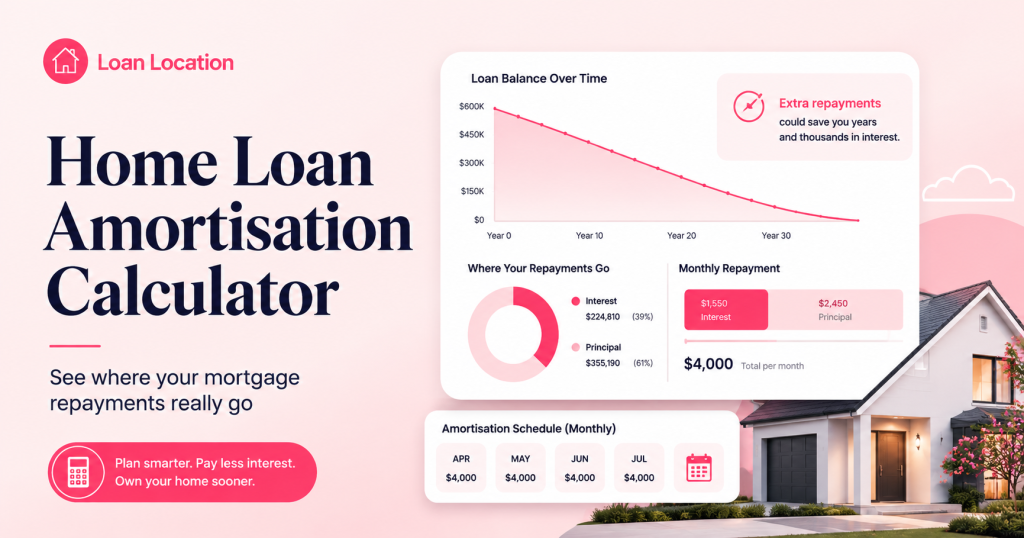
Where does your mortgage repayment actually go?
You make a home loan repayment every month, but the amount leaving your bank account is only half the story. Some pays interest. Some reduces the loan itself. And over time, the balance between the two can change dramatically.
Our new Home Loan Amortisation Calculator lets you see that journey for yourself — including what could happen if you started paying a little extra.
Try the Amortisation CalculatorWhat is home loan amortisation?
Amortisation is simply the process of gradually paying down a loan through regular repayments.
With a typical principal-and-interest home loan, each repayment contains two main parts:
In the earlier years of a long-term mortgage, it can feel frustratingly slow because a substantial portion of each repayment may be going towards interest.
As the balance reduces, the amount of interest charged generally falls too. That means more of your regular repayment can start attacking the principal.
Why your loan can feel like it barely moves at the beginning
Imagine taking out a home loan and enthusiastically checking the balance after your first year of repayments.
You may have paid thousands of dollars to the lender — but the loan balance might not have fallen by anything close to the same amount.
That doesn't mean anything has gone wrong.
Interest is generally calculated against the amount you still owe. When your outstanding balance is at its highest, the interest component of your repayments can also be relatively high.
As the years go on and the principal falls, the numbers can begin working more heavily in your favour.
The interesting question therefore isn't simply:
It's also: “How much of that repayment is actually reducing my mortgage?”
See your home loan repayment schedule for yourself
We've built a new Loan Location Amortisation Calculator to turn those mortgage numbers into something much easier to understand.
Enter your loan amount, interest rate, loan term and starting date, and you can explore how the loan may reduce over time.
You can also see useful milestones such as approximately when 25% of the original balance has been repaid, when the loan reaches half its original balance and when the mortgage is projected to be paid off.
Build My Loan ScheduleWhat happens if you pay a little extra?
This is where an amortisation calculator becomes particularly useful.
Rather than just looking at the home loan you have today, you can test different repayment strategies.
The calculator lets you add an extra monthly repayment and compare the new scenario against the original loan schedule.
You can quickly experiment with amounts such as an extra $50, $100, $250, $500 or even $1,000 per month.
Why can extra repayments make a difference?
Because when additional money reduces the principal earlier, future interest is generally being calculated against a smaller outstanding balance.
Over a long loan term, that compounding effect can become much more interesting than the extra repayment itself.
A small change can look very different over 20 or 30 years
One of the hardest things about mortgages is that humans aren't particularly good at visualising what today's decision does over the next few decades.
Fifty dollars this month doesn't sound enormous.
But that's not really the question.
The better question is what happens if that extra amount is paid consistently and starts reducing the balance earlier.
That's why we've made the comparison interactive.
Start with your current numbers. Then add an extra amount and compare:
- your projected loan balance;
- the amount of interest paid;
- the time remaining on the mortgage; and
- the difference between your original loan path and the new scenario.
You don't need to commit to anything. The point is simply to make the numbers visible.
Amortisation isn't only about making extra repayments
Paying extra is one way borrowers may reduce the amount of interest paid over a home loan, but it isn't the only part of the equation.
The interest rate itself can materially affect how much of your money ultimately goes to the lender.
That's why it can be useful to run the calculator using your existing rate and then test another rate.
For an existing borrower, this can help frame a much bigger question:
A lower rate may reduce interest costs, but the right loan structure also depends on fees, features, remaining loan term, repayment strategy and your broader circumstances.
Offset accounts can change the picture as well
If your home loan includes a genuine offset account, money held in that account may reduce the loan balance used to calculate interest.
That can produce a different outcome from simply looking at the advertised interest rate or scheduled repayment.
Redraw facilities, repayment frequency, lender calculation methods, fees and future interest-rate changes can also affect the real-world result.
Our calculator deliberately keeps the model straightforward so you can clearly see the relationship between the loan balance, interest, principal and extra repayments.
You don't need to be buying a home right now
Run your own mortgage experiment
A good place to start is with your actual home loan rather than a made-up example.
- Enter your current approximate loan balance.
- Enter your current interest rate.
- Enter the remaining loan term.
- Review the original repayment schedule.
- Add a modest extra monthly repayment.
- Compare the new result with the original schedule.
- Try another interest rate and see how the numbers move.
You may discover that the most interesting number isn't your repayment at all.
It may be your projected interest over the remaining life of the loan.
Try the Free CalculatorCould your home loan be working harder?
An amortisation schedule is useful because it turns a mortgage from one giant number into a journey.
You can see where the money goes, when the balance begins falling faster and how changing one assumption can reshape the years ahead.
But a calculator can't tell you whether your current loan is competitive, whether refinancing makes sense, whether an offset is structured properly or whether a different product better suits what you're trying to achieve.
That's where the conversation becomes more useful.
Your mortgage doesn't have to be a 30-year mystery.
Build your amortisation schedule, test some extra repayments and see how your home loan may change over time.
Open the Amortisation CalculatorWant to go beyond the calculator? Talk with a Loan Location mortgage broker and we can help you look at your rate, loan structure and repayment strategy together.