
Australian Inflation • Interest Rates • Home Loans
Australia’s inflation rate has fallen to 3.8% — what could happen next?
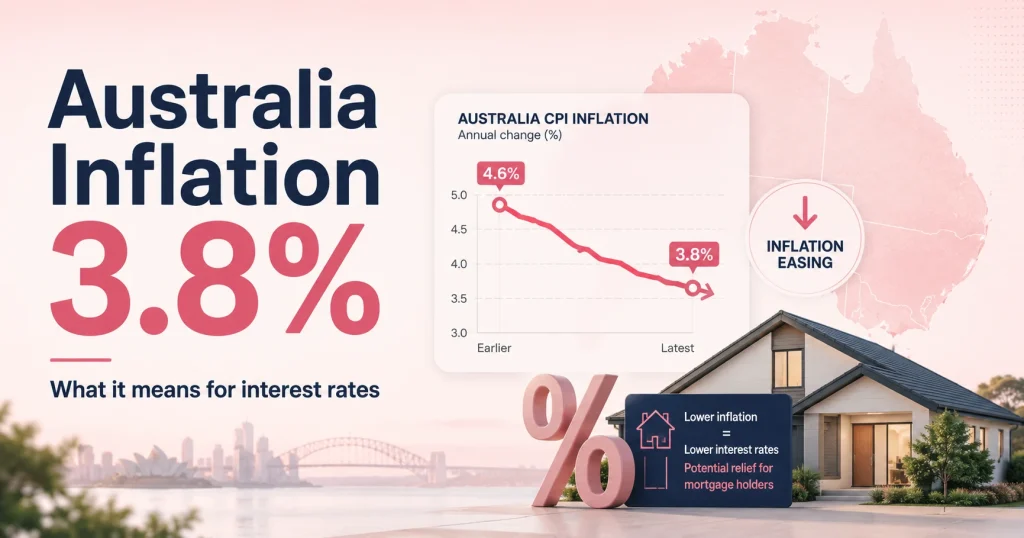
Australia’s annual inflation rate eased to 3.8% in June 2026, down from 4.0% in May and 4.6% in March. For mortgage holders, that is a welcome change in direction after renewed inflation pressure pushed the Reserve Bank of Australia to lift interest rates earlier in the year.
However, one softer inflation result does not automatically mean interest-rate cuts are around the corner. Housing, services and other essential expenses remain expensive, while underlying inflation is still above the RBA’s target range.
Inflation is moving in the right direction, but the fight is not over
Headline inflation has now fallen for three consecutive months. After reaching 4.6% in March, the annual rate eased to 4.2% in April, 4.0% in May and 3.8% in June.
Falling petrol and transport costs helped produce the improvement. At the same time, previous interest-rate increases are beginning to restrict household spending and reduce the ability of businesses to keep lifting prices.
Even so, the RBA will continue watching underlying inflation closely. Trimmed mean inflation remained at 3.6% annually, which is still above the Bank’s 2–3% target range.
Core point: the inflation spike appears to be easing, but the RBA will need more evidence before it can confidently consider reducing interest rates.
1. What the latest CPI figures show
The Consumer Price Index measures changes in the prices Australian households pay for a broad range of goods and services. It includes housing, groceries, fuel, health, education, transport, insurance and many other everyday expenses.
Recent annual CPI figures show that inflation accelerated sharply in March before gradually declining.
| Period | Annual CPI |
|---|---|
| February 2026 | 3.7% |
| March 2026 | 4.6% |
| April 2026 | 4.2% |
| May 2026 | 4.0% |
| June 2026 | 3.8% |
Overall, that sequence suggests the March increase was more likely a temporary inflation shock than the beginning of another uncontrolled surge.
Still, inflation at 3.8% means prices are rising faster than the RBA would prefer. Importantly, falling inflation does not mean prices are returning to earlier levels. It simply means the rate of increase has slowed.
Important distinction: lower inflation means prices are rising more slowly. It does not generally mean household costs are falling.
2. Why the June result was better than expected
In May, the RBA forecast that headline inflation would reach approximately 4.8% by the June quarter. It also expected trimmed mean inflation to reach approximately 3.8%.
Instead, headline CPI came in at 3.8%, while trimmed mean inflation was 3.6%. Therefore, the headline result was around one percentage point below the RBA’s earlier forecast.
Much of the difference appears to reflect lower fuel prices and a smaller flow-on effect from earlier energy-market disruption. Previously, the RBA had warned that higher fuel and raw-material costs could spread into freight, groceries, travel, construction and other business expenses.
So far, that broader pass-through appears to have been weaker than feared. As a result, the RBA has more room to leave rates unchanged while it watches the next few inflation and employment releases.
Why it matters: inflation coming in below the RBA’s forecast reduces the pressure for another immediate interest-rate increase.
3. What is helping inflation fall?
Lower petrol and transport costs
Fuel prices were a major driver of the March inflation spike. Since then, global oil prices have eased and petrol has stopped adding the same level of pressure to household expenses.
In addition, lower fuel prices can reduce costs throughout the economy. Freight companies, airlines, builders, retailers and food suppliers all rely on transport, so sustained relief may eventually flow through to other prices.
Goods inflation is cooling
Price growth for many physical goods has slowed as supply conditions improve and consumers become more cautious. Meanwhile, households facing higher mortgage repayments are generally less able to absorb repeated price increases.
Interest rates are reducing demand
During 2026, the RBA increased the cash rate three times before leaving it unchanged at 4.35% in June. Those increases have raised repayments for many variable-rate borrowers and tightened financial conditions across the economy.
Consequently, households have less money available for discretionary spending. Over time, weaker demand makes it harder for businesses to continue lifting prices without losing customers.
The uncomfortable trade-off: higher interest rates can help reduce inflation, but mortgage holders carry a large part of the immediate cost.
4. Why underlying inflation still matters
Headline CPI can move quickly because it includes volatile items such as petrol, electricity, fresh food and travel. For that reason, the RBA also watches trimmed mean inflation.
Trimmed mean CPI removes some of the largest price increases and decreases from each period. Therefore, it provides a clearer view of whether inflation pressure is widespread and persistent.
Annual trimmed mean inflation remained at 3.6% in June. Although this was better than the RBA had forecast, it is still too high to declare the inflation problem solved.
Services inflation is especially important because it reflects domestic expenses such as wages, rents, insurance, education, health, maintenance and professional services. Unlike petrol or imported goods, these costs often take longer to slow.
What the RBA wants to see: underlying and services inflation moving consistently towards 3%, rather than a temporary fall caused mainly by cheaper petrol.
5. Housing remains one of Australia’s largest inflation problems
Housing costs remain a major source of pressure for Australian households. The category includes rents, electricity, new dwelling construction and property-related services.
Home-building costs were reported to be approximately 5.8% higher over the year, while rents increased by approximately 3.6%. Electricity costs and changes to government rebates have also affected the headline CPI figure.
Unfortunately, interest rates cannot quickly resolve many of these issues. Australia continues to face housing shortages, limited rental supply, expensive building materials and labour constraints in the construction industry.
Higher interest rates can also make new development less viable. In turn, that may slow construction and prolong the shortage of available housing.
Buyers who remain active should therefore test their budget carefully. This applies whether they are seeking first-home buyer finance or reviewing finance for an investment property.
Why housing inflation is stubborn: interest rates can reduce demand, but they cannot quickly create more homes, tradespeople or building materials.
6. Is inflation likely to keep falling?
The most likely direction is lower, although the decline may be uneven. Monthly inflation can move sharply when fuel, electricity, travel or government-administered prices change.
In its May baseline forecast, the RBA expected headline inflation to decline after the June peak as fuel prices eased. It projected headline CPI at approximately 4.0% by December 2026, 2.4% by June 2027 and 2.5% by June 2028.
Because the actual June result was much lower than the RBA’s 4.8% forecast, its near-term headline inflation projection may be revised down. Even so, underlying inflation may not fall at the same speed.
Inflation could fall faster if:
- Petrol and oil prices remain lower.
- Household spending weakens further.
- Wage growth and business costs moderate.
- Productivity improves.
- Construction and insurance cost increases slow.
- The Australian dollar helps contain imported inflation.
However, inflation could rise again if:
- Another global energy or oil shock occurs.
- Electricity rebates or temporary support measures expire.
- Services inflation remains around 4%.
- Housing and rental shortages worsen.
- Businesses continue passing higher labour costs to customers.
- Inflation expectations become embedded in wage and pricing decisions.
7. What does this mean for interest rates?
The June result substantially reduced the likelihood of an immediate rate increase. Following the CPI release, financial-market pricing reportedly placed only a small probability on an August hike.
Nevertheless, the RBA is unlikely to rush into cutting rates. Headline inflation remains above target, trimmed mean inflation is 3.6% and housing and services costs remain elevated.
For now, the most realistic outcome is an extended period with the cash rate held at 4.35%. This would allow the RBA to assess whether weaker spending and previous rate rises are producing a sustained fall in inflation.
Rate cuts become more likely once underlying inflation moves convincingly towards 3%. The RBA will also want to see services inflation ease and evidence that another inflation surge is unlikely.
On the current evidence, meaningful rate relief appears more plausible during 2027 than during the remainder of 2026.
Borrower takeaway: another immediate rate increase now looks less likely, but borrowers should not build their budget around rapid rate cuts.
8. What mortgage holders should consider now
Waiting for the RBA to cut rates is not the only way to improve a home loan position. Your lender’s existing customer rate, loan structure and fees can matter just as much as the next cash-rate decision.
Review your current interest rate
Start by comparing your rate with the pricing available to new customers and similar borrowers. Long-term clients can sometimes remain on less competitive rates unless they actively request a review.
Check whether your loan structure still suits you
An offset account, redraw facility, fixed split or interest-only period may have suited you when the loan began. However, your needs may now be different.
Consider the full cost before refinancing
A lower advertised rate does not automatically produce a better outcome. Instead, consider discharge fees, application costs, annual package fees, loan terms and feature differences.
A proper home loan refinance review should compare the total cost and structure rather than focusing only on the headline rate.
Do not rely on predicted rate cuts
Economic forecasts can change quickly. Therefore, build your budget around repayments you can manage now and treat future rate reductions as a possible benefit rather than a certainty.
Home loan inflation checklist
These practical checks may help borrowers manage a period of higher-for-longer interest rates.
- Check your current rate: confirm the actual rate applying to every loan split.
- Review lender discounts: ask whether better pricing is available without refinancing.
- Check your offset: confirm it is linked to the correct eligible loan split.
- Review fixed-rate expiry dates: understand when each split may revert to a variable rate.
- Compare repayments: test your budget at current rates and at a slightly higher rate.
- Review unused credit: credit card limits can affect borrowing capacity even when balances are low.
- Consider your loan term: lower repayments over a longer term may increase total interest paid.
- Compare the full cost: include rates, fees, features and refinance expenses.
- Seek help early: speak with your lender or broker before repayments become unmanageable.
The bottom line
Australia’s inflation rate is moving in the right direction. Headline CPI has fallen from 4.6% in March to 3.8% in June, while the latest result was considerably softer than the RBA expected.
As a result, the chance of another immediate interest-rate rise has reduced. However, inflation remains above target and underlying pressure is still present in housing, services and other essential expenses.
The most likely path is a gradual decline in inflation rather than a rapid return to very low interest rates. Mortgage holders should therefore remain cautious, review their current lending position and avoid assuming that substantial rate cuts are imminent.
Final thought: the June result is a positive turning point, not a declaration of victory. Inflation is easing, but the RBA still needs proof that the improvement will last.
Key information sources
This article draws on inflation data and economic commentary published by the Australian Bureau of Statistics and the Reserve Bank of Australia.
- Australian Bureau of Statistics — Consumer Price Index, Australia
- Reserve Bank of Australia — Statement on Monetary Policy, May 2026
- Reserve Bank of Australia — Economic outlook and inflation forecasts
- Reserve Bank of Australia — Monetary Policy Decision, 16 June 2026
Forecasts and market expectations can change as new inflation, employment, wages and economic data become available.
Wondering whether your home loan is still competitive?
Inflation and RBA decisions affect the wider lending market. However, your individual outcome also depends on your current rate, loan structure, equity, repayments and lender policy.
Loan Location can review your existing home loan, compare available options and explain whether negotiating with your current lender or refinancing may be worth considering.
Note: This is general information only and does not take into account your personal objectives, financial situation or needs. Interest rates, lender policies, fees, product availability and eligibility criteria can change. Before making a lending decision, consider whether the option is appropriate for your circumstances.